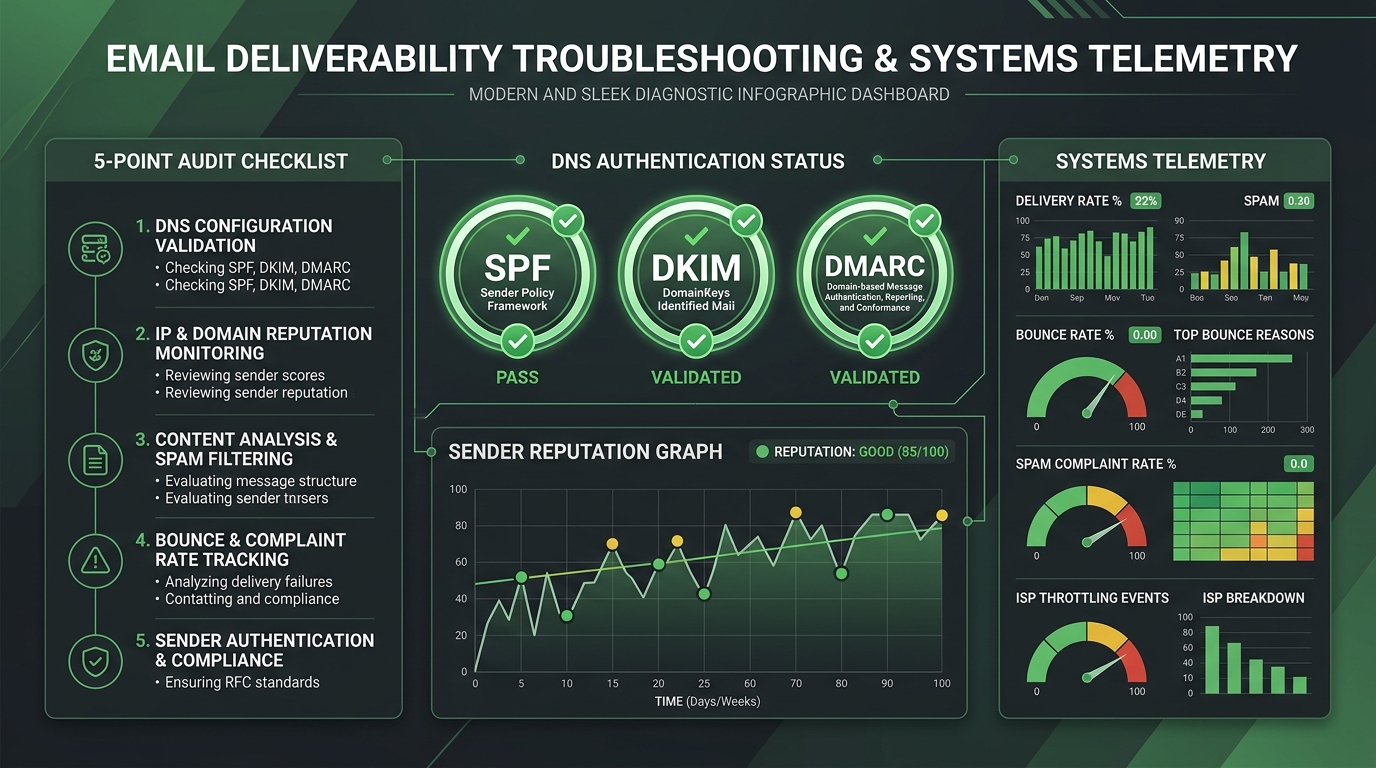
Across more than 500 email infrastructure audits, a consistent pattern appears. Companies launch large marketing or outbound campaigns with tremendous confidence. Their email service provider dashboard turns green. The counter ticks upward, showing a 99.2% delivered status. The marketing director assumes the campaign succeeded.
Two days later, replies remain at zero, demo bookings flatline, and open rates drop below 8%. When investigating the mail server logs, we discover that 80% of those messages landed directly in the recipient junk folder or were silently quarantined by Microsoft 365 and Google Workspace.
This is the essence of vibe mailing. It is the dangerous assumption that hitting the send button and seeing a successful transmission report means your audience actually received the email in their primary inbox. To diagnose whether your sending operations are guided by rigorous engineering or pure intuition, run through this 5-point symptom test.
Symptom 1: You Confuse SMTP Handover with Inbox Placement
The first and most widespread symptom of vibe mailing is trusting the delivery rate metric reported inside platforms like Mailchimp, Klaviyo, Brevo, or HubSpot.
From an ISP network engineering perspective, an email delivery rate measures only one technical event: an SMTP 250 OK status code. This means the receiving gateway (such as Google mx.google.com or Microsoft mail.protection.outlook.com) accepted the transmission of the data packet over port 25 without an outright network bounce. It confirms delivery to the mail server, not to the human inbox.
Modern receiving filters inspect message headers, Bayesian content models, and historical sender reputation after that 250 OK handshake is completed. If your domain lacks sender authority, the mailbox provider silently deposits the email into the spam folder. When you want to diagnose sudden drops in email deliverability within 24 hours, your first step must be separating server acceptance from inbox arrival.
The Test Question for Symptom 1
Does your weekly marketing report cite delivery rate as proof of inbox visibility? If yes, you are diagnosing your infrastructure with blinders on.
Symptom 2: You Rely on DMARC p=none as a Security Policy
According to research from the Messaging, Malware and Mobile Anti-Abuse Working Group (M3AAWG) and IETF standards under RFC 9989, email authentication is no longer optional. Yet thousands of senders publish a bare-minimum DMARC record such as v=DMARC1; p=none; and assume their domain is protected.
A policy of p=none is purely an observation mode. It instructs receiving mail servers to take no enforcement action when spoofed, fraudulent, or misaligned emails impersonate your brand. Scammers can send phishing emails using your exact from-address, and mailbox providers will deliver them. As spam complaints roll in against your domain name, your overall domain reputation craters.
Furthermore, major mailbox providers treat persistent p=none domains with skepticism. To protect your brand equity, you must execute a structured roadmap for transitioning from DMARC p=none to p=reject without lost traffic, ensuring strict cryptographic alignment across both SPF and DKIM signatures.
Symptom 3: You Have Never Logged into Google Postmaster Tools or Microsoft SNDS
If you only look at your sending tool and never look at the receiving ISP consoles, you are flying through thick fog without radar. This is the third classic hallmark of vibe mailing.
Google enforces a strict spam complaint limit: your user-reported complaint rate must remain strictly below 0.10%, with a hard failure cliff at 0.30%. Once your domain exceeds 0.30% in Google Postmaster Tools, Google downgrades your domain reputation from High to Bad. When this happens, even your password resets and critical billing receipts begin landing in the spam folder.
Similarly, Microsoft Smart Network Data Services (SNDS) provides raw IP complaint rates and spam trap hit counts across Hotmail and Outlook accounts. Senders who operate on actual deliverability telemetry monitor these dashboards before and after every major send, spotting reputation degradation long before open rates collapse.
Symptom 4: You Trigger Massive Volume Spikes Without Cadence Pacing
Automated reputation algorithms at Spamhaus, Yahoo, and Gmail evaluate traffic volatility. In human communication, legitimate organizations build sending volume steadily over weeks.
Vibe mailers operate in spikes. They maintain low volume for three weeks, and then suddenly blast 65,000 promotional emails on Tuesday at 9:00 AM. To an automated anti-abuse filter, sudden 10x volume surges look indistinguishable from compromised botnet compromised accounts. The immediate response from receiving mail transfer agents (MTAs) is rate-limiting, temporary 421 deferrals, and automated routing to bulk folders.
A disciplined sender implements a pragmatic IP warmup and sender reputation strategy, organizing subscriber lists into engagement cohorts and throttling hourly dispatch rates to stay well within ISP concurrency thresholds.
Symptom 5: You Trust Synthetic Peer-to-Peer AI Warmup Pools
The fifth symptom represents the modern evolution of vibe mailing: relying on automated cold-email warmup tools that send fake, robotic emails back and forth between thousands of scrap inboxes.
Machine learning filters at Google and Microsoft easily identify synthetic warmup networks. These algorithms analyze linguistic variation, timing anomalies, thread depth, and recipient clustering. When an ISP flags your domain as a participant in an artificial reputation manipulation ring, your domain receives a hidden penalty that standard DNS checks cannot detect.
Authentic sender reputation cannot be manufactured by bots talking to bots. It requires verified opt-in consent, clean list verification, low unsubscribe friction via RFC 8058 one-click headers, and real human interactions. This principle was detailed in our original vibe mailing systems engineering analysis.
The Symptom Scorecard: What Your Result Means
Review the five symptoms above and calculate your organization's score:
| Yes Count | Operational Diagnosis | Immediate Action Needed |
|---|---|---|
| 0 out of 5 | Engineered Deliverability Telemetry | Maintain active DMARC aggregate monitoring and quarterly DNS alignment audits. |
| 1 to 2 out of 5 | Early-Stage Vibe Mailing | Implement Google Postmaster Tools and map DKIM selectors to close authentication loopholes. |
| 3 to 5 out of 5 | Severe Infrastructure Breakdown | Halt volume spikes immediately and conduct a full root-cause investigation across DNS, sending servers, and list hygiene. |
Why Business Owners Shouldn't Play Mail Server Engineer
Looking at this 5-point checklist, an obvious question arises for founders and executives: how can a business owner run a company while constantly monitoring DNS TXT records, analyzing XML aggregate reports, and calculating ISP concurrency curves?
The short answer is you should not. A founder's highest-leverage work involves product direction, customer relationships, hiring, and revenue growth. Trying to moonlight as a part-time mail transfer agent administrator produces operational exhaustion, and it almost always leads to cut corners, which is how vibe mailing starts in the first place.
This is precisely why high-performing businesses hire an experienced email campaign manager and retain an email deliverability specialist. When you place a professional at the helm of your email operations, the division of labor becomes clean:
- The Business Owner: Focuses on offer strategy, messaging angle, business scaling, and high-level marketing goals without worrying about backend protocol failures.
- The Dedicated Campaign Manager: Takes ownership of daily list hygiene, audience segmentation, engagement tiering, and schedule cadence, ensuring every send meets strict ISP standards.
- The Deliverability Specialist: Actively monitors Google Postmaster Tools telemetry, parses DMARC reports, manages IP warmup curves, and catches reputation dips long before they hurt revenue.
Whether you need certified Mailchimp campaign management and automation consulting to run clean, revenue-generating workflows, or ongoing email infrastructure consulting and deliverability management to safeguard high-volume sender reputation, having dedicated oversight turns email from a stressful gamble into a predictable growth engine.
Moving from Intuition to Engineering
Email delivery is not marketing magic; it is an interconnected network stack governed by precise IETF internet standards, cryptographic keys, and reputation algorithms. When you treat email as a software discipline rather than a guessing game, your inbox placement becomes predictable and resilient.
If your team scored three or higher on this diagnostic test, or if you are observing unexpected spam folder placement across your transactional or marketing workflows, schedule a comprehensive email infrastructure deliverability audit. We inspect your server configurations, cryptographic alignments, and ISP reputation scores to eliminate the guesswork for good.